
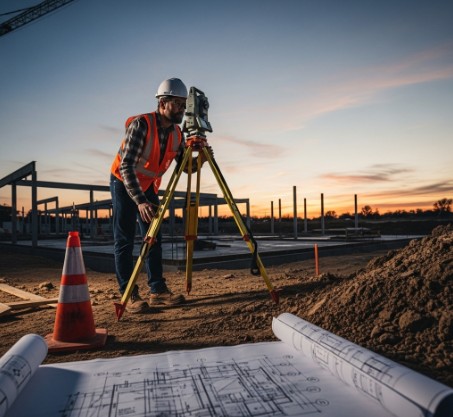
For any construction project, big or small, a strong and accurate foundation is key. But before the first shovel of earth is turned, a critical process known as building setting out must be completed. This is the art of transferring the detailed plans from an architectural drawing onto the actual building site. Think of it as laying out the blueprint directly on the ground, ensuring that the building’s size, shape, and location are exactly as specified. Without this crucial step, mistakes can happen that are costly and difficult to fix later on.
The process of setting out begins with the preparation of the site. Workers clear the area of any vegetation or debris and level the ground. Next, a surveyor or engineer establishes a baseline, which is a fixed reference line from which all other measurements will be taken. This baseline acts as the main guide for the rest of the layout. With the baseline in place, the team can use measuring tools to mark the corners of the building and the lines for the foundation trenches. They often use pegs, strings, and chalk to make these marks clear and visible on the ground.
For smaller buildings, you can complete the setting out process with basic tools. A measuring tape, a builder’s square, and string lines are often enough to accurately mark out the foundation. You can use the 3-4-5 method with a tape measure to create a perfect right angle, which is a simple and effective way to ensure corners are square. Precision is extremely important throughout this process. A small error in the initial layout can become a major problem later on, causing the building to be out of alignment. That’s why an accurate land survey is vital before any setting out begins, providing the precise data needed for a successful layout.
For more complex projects, like bridges or skyscrapers, modern technology is necessary for a precise layout. Engineers now use advanced equipment such as total stations. These electronic devices can measure angles and distances with incredible accuracy, making the building setting out process faster and more reliable on large-scale sites. Regardless of the tools used, the goal remains the same: to ensure the finished structure matches the design flawlessly.
Ultimately, building setting out is the unseen hero of a construction project. It’s the meticulous work that happens before the concrete is poured and the walls go up. By carefully transferring the design from paper to the ground, you can build a stable and long-lasting structure. Understanding this fundamental process is essential for anyone involved in civil engineering and construction, as it truly is the foundation for all successful builds.
To learn more about the different methods and challenges in building setting out, visit The Institution of Civil Engineers’ website.
References
- The Institution of Civil Engineers (ICE). (n.d.). Site Engineering. Retrieved from https://www.ice.org.uk/
- B.S. Punmia, Ashok Kumar Jain, & Arun Kumar Jain. (2016). Building Construction. Laxmi Publications.
Ching, F. (2014). Building Construction Illustrated. John Wiley & Sons.
Leave a Reply