
Bricks are one of the oldest and most trusted building materials in human history. From ancient pyramids to modern homes in Nigeria, the humble brick has provided shelter and security for centuries. But brick production is no longer just about mixing mud and straw.
Today, technology has transformed the way bricks are made, leading to stronger, more uniform, and more environmentally friendly products. This guide explores the journey of a brick from simple earth to a high-quality building component, looking at both traditional and modern methods.
The Basic Method: How Bricks Have Always Been Made
The traditional method of making bricks, often called the “soft mud” method, has been used for thousands of years and is still practiced in many small-scale operations. The process involves four main steps:
- Tempering (Mixing): Clay or shale is dug from the ground and mixed with water to create a thick, workable paste. Sometimes, sand is added to reduce shrinkage and cracking.
- Moulding: The wet clay mixture is then pressed into rectangular wooden or metal moulds by hand. Excess clay is scraped off the top to create a flat surface.
- Drying: The “green” (wet) bricks are carefully removed from the moulds and arranged in a sheltered area to air-dry for several days or weeks. This slow drying process prevents them from cracking before they are fired.
- Firing: Once dry, the bricks are stacked in a special oven called a kiln. They are heated to a very high temperature (between 900°C and 1200°C) for several days. This firing process vitrifies the clay particles, turning them into a hard, durable, and water-resistant ceramic material.
While effective, this method often produces bricks with slight variations in size, shape, and strength.
Modern Production: Stronger Bricks Through Technology
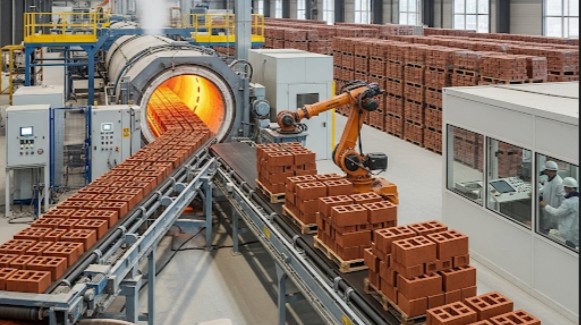
Modern brick production uses advanced machinery to create superior quality bricks with remarkable consistency. The two primary modern methods are extrusion (stiff mud) and dry-pressing.
1. The Extrusion (Stiff Mud) Method
This is the most common method used in large-scale brick plants today.
- Process: Clay is mixed with less water than in the traditional method, creating a very stiff mud. This mixture is fed into a machine called an extruder. The extruder forces the clay through a die (a precisely shaped opening) to produce a continuous column of clay with the exact dimensions of a brick.
- Improvement: As the clay column exits the machine, it is cut into individual bricks by an automated wire-cutting system. This process ensures that every brick is identical in size and shape. The high pressure used in extrusion also compacts the clay, creating denser and stronger bricks from the very start.
2. The Dry-Press Method
This method is used for clays with very low moisture content.
- Process: A mixture of clay and a small amount of water (about 10%) is placed into steel moulds. A powerful hydraulic or mechanical press then applies immense pressure to the clay, compacting it into a solid brick shape.
- Improvement: This method produces highly dense bricks with sharp edges, smooth surfaces, and excellent dimensional accuracy. Because very little water is used, the drying time before firing is significantly reduced, making the process faster and more energy-efficient.
Modern kilns are also computer-controlled, ensuring that every brick is fired at the perfect temperature for the exact amount of time. This eliminates the inconsistencies of traditional kilns and guarantees maximum strength and durability.
How to Check the Quality of Bricks Before You Buy
You don’t need a lab to spot a good brick. Here are five simple field tests you can perform to ensure you’re getting your money’s worth:
- Uniformity Check: Stack a few bricks together. They should all be the same size, shape, and colour. This indicates they came from a modern, controlled manufacturing process.
- Hardness Test: Scratch the surface of the brick with your fingernail or a key. If it leaves a significant mark, the brick is too soft and not well-fired. A good brick should resist scratching.
- Sound Test: Hold two bricks and strike them against each other. They should produce a clear, metallic ringing sound. A dull thud means the brick is cracked or poorly fired and is likely weak.
- Drop Test: Take a brick and drop it from a height of about 1.5 meters (about chest height) onto hard ground. A high-quality brick should remain intact and not break or shatter.
- Water Absorption Test: Weigh a dry brick, then submerge it in water for 24 hours. Weigh it again. A good quality brick should not have absorbed more than 20% of its original weight in water. While you can’t do this perfectly on-site, a brick that feels significantly heavier after a brief soaking is too porous.
By choosing high-quality, modern-produced bricks, you are investing in the safety, durability, and long-term value of your building project.
References
- Building Research Establishment (BRE). (1995). “Clay Bricks and Clay Brick Masonry.” BRE Digest 362.
- The Brick Development Association. (2011). “Manufacturing Clay Bricks.” Brick Bulletin, Winter 2011.
- Indian Standard IS 3495 (Parts 1-4): 1992. “Methods of Tests of Burnt Clay Building Bricks.” Bureau of Indian Standards.
Leave a Reply