
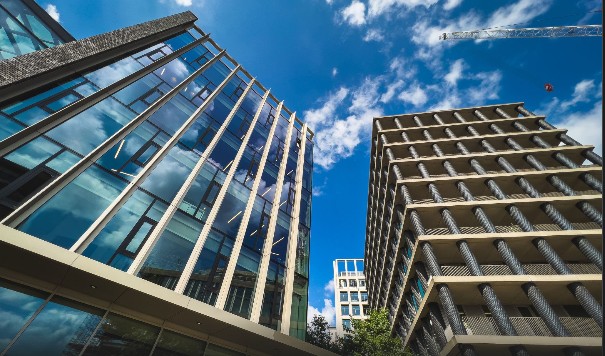
Structural engineering is evolving rapidly, moving far beyond traditional concrete and steel blueprints. New materials, smart technology, and a focus on sustainability are creating stronger, safer, and more efficient buildings. Here’s a look at the innovations and future trends shaping the world around us.
Smarter and Stronger Materials
The very materials used to build our structures are getting a high-tech upgrade. Instead of just being strong, they are becoming intelligent and more sustainable.
- Self-Healing Concrete: Imagine a crack in a wall that fixes itself. Scientists have developed concrete mixed with special bacteria or capsules containing a healing agent. When a crack forms, water gets in, activating the agent to seal the gap, extending the building’s life and reducing repair costs.
- Mass Timber: Wood is making a big comeback. Cross-laminated timber (CLT) involves gluing layers of wood together to create massive, strong panels. These panels are as strong as steel but much lighter and more environmentally friendly, as they store carbon instead of producing it.
- Advanced Composites: Materials like carbon fiber reinforced polymers (CFRP) are incredibly strong yet lightweight. Initially used in aerospace, they are now being used to strengthen existing bridges and buildings or to create new, innovative architectural shapes that would be impossible with traditional materials.
The Digital Revolution
Technology is changing how structures are designed, built, and maintained. Digital tools are making the entire process smarter and more collaborative.
- Building Information Modeling (BIM): BIM is much more than a 3D model. It’s a digital representation of a building that includes every detail, from the largest beam to the smallest screw. It allows architects, engineers, and construction teams to work together on a single, shared model, catching problems before construction even begins.
- Digital Twins: A digital twin is a virtual copy of a real-life building. It’s connected to the actual structure through sensors that feed it real-time data on things like temperature, stress, and vibrations. This allows engineers to monitor the building’s health, predict maintenance needs, and simulate how it would react to events like an earthquake.
- Artificial Intelligence (AI) and Drones: AI can analyze thousands of design options to find the most efficient and cost-effective one. On the construction site, drones are used to survey the land, monitor progress, and inspect hard-to-reach places, making the job safer and faster.
Building for a Greener Future
Sustainability is no longer an option; it’s a necessity. Structural engineers are now at the forefront of creating buildings that are both safe for people and good for the planet.
- Resilient Design: With climate change bringing more extreme weather, buildings need to be tougher. Engineers are designing structures that can withstand hurricanes, floods, and higher temperatures. This includes features like elevated foundations in flood-prone areas or flexible structures in earthquake zones.
- The Circular Economy: Instead of “take, make, waste,” the goal is to design buildings where materials can be reused or recycled at the end of their life. This involves choosing materials that can be easily disassembled and creating a plan for their future use, reducing landfill waste.
Printing the Future: 3D Printing and Robotics
Automation is set to transform the construction site. Robots and 3D printers are taking on tasks that are dangerous, repetitive, or require high precision.
Large-scale 3D printers can now build walls by extruding layers of concrete or other materials, creating basic structures in a fraction of the time and with less waste. Similarly, robots are being used on-site to lay bricks, tie reinforcing steel, and perform other manual labor tasks, improving speed and safety. This technology is still developing, but it holds the promise of making construction cheaper, faster, and more customizable.
Leave a Reply