
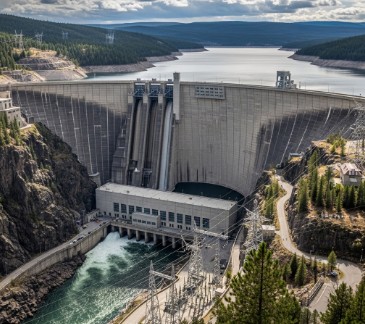
Have you ever seen a picture of a giant wall holding back a massive lake? That wall is a dam, and it’s one of the most impressive things humans can build. Dams are more than just concrete barriers; they are carefully planned and constructed structures that play a huge role in our daily lives. They provide us with electricity, water for our farms, and protection from floods. But how exactly do we build these enormous structures that can tame mighty rivers? Let’s dive into the amazing world of dam construction.
Why Do We Build Dams?
Before we look at how dams are built, it’s important to know why we need them. Dams serve several key purposes:
- Hydroelectric Power: The force of the water held back by a dam can be used to spin large turbines, which generate electricity. This is a clean and renewable source of energy.
- Water Supply: The large lake, or reservoir, created behind a dam stores water. This water can be used for drinking, for industries, and most importantly, for watering crops (irrigation), especially in dry areas.
- Flood Control: In areas where rivers often overflow their banks, dams can hold back excess rainwater and release it slowly and safely, preventing destructive floods.
- Recreation: The reservoirs behind dams often become popular spots for boating, fishing, and other recreational activities.
The Building Blocks: Types of Dams
Not all dams are the same. Engineers choose a specific type of dam based on the size of the river, the shape of the valley, and the type of ground available. Here are the main types:
- Gravity Dams: These are the heavyweights. Made from a massive amount of concrete or stone, a gravity dam uses its sheer weight to hold back the water. It’s like a giant, heavy bookend leaning against the water.
- Arch Dams: These dams are curved, like an arch lying on its side, with the curve facing the water. The arch shape is incredibly strong and transfers the force of the water to the rocky walls of the valley. They use less material than gravity dams but need very strong rock on the sides to push against.
- Buttress Dams: These dams have a sloping wall that is supported by a series of buttresses (supports) on the downstream side. The buttresses help to brace the wall and transfer the water’s force to the ground.
- Embankment Dams: These are the most common type of dam. Instead of concrete, they are built from compacted earth, clay, and rock. They are massive, wide structures, like a natural mountain, with a waterproof core (often made of clay) in the middle to stop water from seeping through.
How a Dam is Built: A Step-by-Step Guide
Building a dam is a massive undertaking that takes years and follows a careful plan. Here’s a general look at the steps involved.
Step 1: Finding the Right Spot
First, engineers and geologists study maps and survey the land to find the perfect location. They look for a narrow valley with strong rock on the sides and foundation. The rock needs to be solid enough to support the immense weight of the dam and the force of the water.
Step 2: Diverting the River
You can’t build a dam in the middle of a flowing river. So, the first major construction task is to divert the water around the worksite. This is usually done in one of two ways:
- Diversion Tunnels: Large tunnels are dug through the rock on the sides of the valley.
- Coffer Dams: Temporary dams, called cofferdams, are built upstream and downstream of the construction area. The river’s flow is then channelled through the tunnels, leaving the riverbed in between the cofferdams dry and ready for construction.
Step 3: Preparing the Foundation
With the riverbed dry, excavation begins. All loose soil, sand, and weak rock are removed until a solid rock foundation is reached. This is a critical step because the entire dam will rest on this foundation. Any weakness here could lead to disaster. Cracks in the foundation rock are often filled with a special type of cement called grout to make it stronger and more watertight.
Step 4: Building Upwards
Once the foundation is ready, the main structure of the dam is built.
- For a concrete dam (like a gravity or arch dam), the concrete is poured in large blocks called lifts. Pouring it all at once would generate too much heat from the chemical reaction in the concrete, causing it to crack. Pipes with cold water are often run through the concrete to help it cool down evenly.
- For an embankment dam, giant trucks and earth-moving equipment bring in tons of soil, clay, and rock. These materials are laid down in layers, and each layer is heavily compacted with massive rollers to squeeze out any air and make it dense and stable.
Step 5: Adding the Finishing Touches
The work isn’t over when the main wall is up. Other important parts must be added:
- The Spillway: This is a crucial safety feature. It’s like an overflow drain in a bathtub. If the water in the reservoir gets too high (for example, after heavy rain), the spillway allows the excess water to flow out in a controlled way, preventing it from overflowing the top of the dam.
- The Outlet Works: These are pipes and gates that allow operators to release water from the reservoir for irrigation, water supply, or to maintain a certain flow in the river downstream.
- The Powerhouse: If the dam is for hydroelectricity, a powerhouse is built, usually at the base of the dam. It contains the turbines and generators that produce electricity.
A True Feat of Engineering
From diverting entire rivers to pouring millions of tons of concrete, building a dam is a testament to human ingenuity and power. These structures are carefully designed to stand for centuries, harnessing the power of water for the benefit of society. While they also bring environmental challenges that must be managed, there is no denying that holding back the waters with these man-made mountains is one of engineering’s greatest marvels.
Leave a Reply