
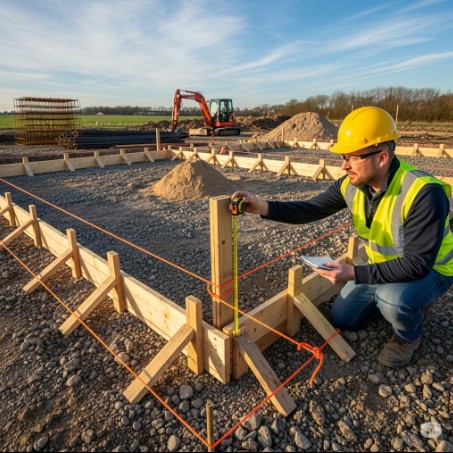
For small construction projects, like a bungalow or a home, the first step is a critical process known as setting out small buildings. This involves transferring the building’s plan from paper to the actual site. While modern technology is great for large projects, you can accurately lay out a small building using a simple, effective method: profile boards and ropes. This guide will walk you through the practical steps to ensure your foundation is positioned correctly and your corners are perfectly square.
The key to this method is the profile board, a simple structure you create at each corner of the planned building. A profile board consists of two upright stakes driven into the ground, with a horizontal plank nailed across them. You should place these profile boards a meter or two away from the actual corner of the building. This distance is important because it keeps the profiles from being disturbed when workers dig the foundation trenches. Once the profile boards are in place, you can stretch taut ropes or wires between them. These ropes act as the exact lines for the building’s outer walls, defining where the foundation trenches will be dug.
The next step is to ensure that your building’s corners form perfect right angles. You can do this easily using the 3-4-5 method. Using a measuring tape, measure 3 meters along one string line from a corner peg, and 4 meters along the other. If the diagonal distance between these two points is exactly 5 meters, you have a perfect right angle. You must check every corner in this way to avoid any potential errors. This simple check is a fundamental part of the setting out small buildings process and guarantees that your walls will meet at a precise 90-degree angle.
During this process, you may face a few challenges. For example, if the ground is uneven, you must ensure that your profile boards are installed at the same height. You can use a level and a straightedge to mark a consistent height on each board. Another common issue is site constraints, such as nearby trees or fences that prevent you from placing a profile board. In these cases, you can extend your baseline further out or use an intermediate profile to ensure all measurements are accurate. By being meticulous and double-checking your work, you can overcome these issues and guarantee a successful layout.
The successful setting out small buildings is the cornerstone of a stable structure. The use of profile boards and ropes, while traditional, is a reliable and accurate method that puts the power of precision in your hands. Taking the time to properly lay out your foundation will prevent future problems and save you from costly mistakes. By following these steps, you are ensuring your project is built on a solid foundation from the very beginning.
To gain a deeper understanding of practical surveying methods in construction, you can find useful resources on the National Society of Professional Surveyors’ website.
References
- Chudley, R., & Greeno, R. (2014). Building Construction Handbook. Routledge.
- Seeley, I. H. (1997). Building Technology. Macmillan Education.
- National Society of Professional Surveyors (NSPS). (n.d.). Surveying Principles. Retrieved from https://www.nsps.us.com/
Leave a Reply