
Understanding Fundamental Soil Properties
Soil is more than just dirt; it’s a complex material with unique properties that are critical to civil engineering and construction. Understanding how soil behaves under different conditions is essential for building safe and stable structures. This article will break down three important soil properties: bulk density, shear strength, and consolidation, explaining them in simple English with clear examples.
What is Bulk Density?
Imagine you have a bucket and you fill it with soil. The bulk density of that soil is simply the total mass of all the stuff inside the bucket divided by the total volume of the bucket. This “stuff” includes the solid soil particles, the water in the pores, and the air trapped in the gaps.
Think of it this way: a dry, loose soil will have a lower bulk density because it contains a lot of air. If you add water, the water fills the gaps, making the soil heavier for the same volume, so the bulk density increases. If you compact the soil, you squeeze out the air and the particles get closer together, which also increases the bulk density. Engineers use bulk density to calculate the weight of soil, which is crucial for designing foundations and retaining walls.
What is Shear Strength?
Shear strength is a soil’s ability to resist sliding or shearing forces. It’s what prevents a slope from collapsing or a foundation from pushing the soil out from underneath it. In simple terms, it’s the internal friction and cohesion that holds the soil together.
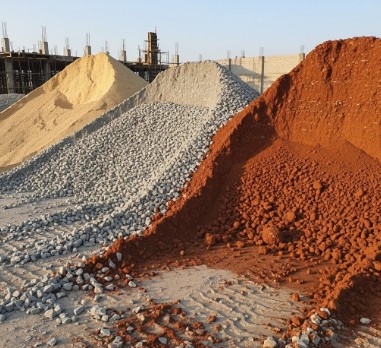
A good example is a pile of sand. If the sand is dry, you can’t build a very steep pile; it will just slide down. This is because dry sand has very little cohesion, and its shear strength comes only from friction between the grains. Now, if you add a little water to the sand, the surface tension of the water creates cohesion, and you can build a much steeper sandcastle. This is because the water has increased the soil’s shear strength. The shear strength of soil is vital for designing stable slopes, excavations, and foundations.
What is Consolidation?
Consolidation is the process where a saturated soil decreases in volume over time due to an applied load, like a building. When you place a heavy object on a soft, wet soil, the load squeezes the water out of the tiny spaces (pores) between the soil particles. As the water is expelled, the soil particles move closer together, causing the ground to settle.
A great example of this is a new building constructed on a soft clay soil. Immediately after construction, the building’s weight starts to compress the soil. Over months or even years, the excess water is slowly squeezed out, and the soil beneath the building gradually consolidates. This process causes the building to slowly settle. Engineers must predict the amount and rate of this consolidation to ensure the building’s foundation is designed to handle the settlement without damage.
Leave a Reply