
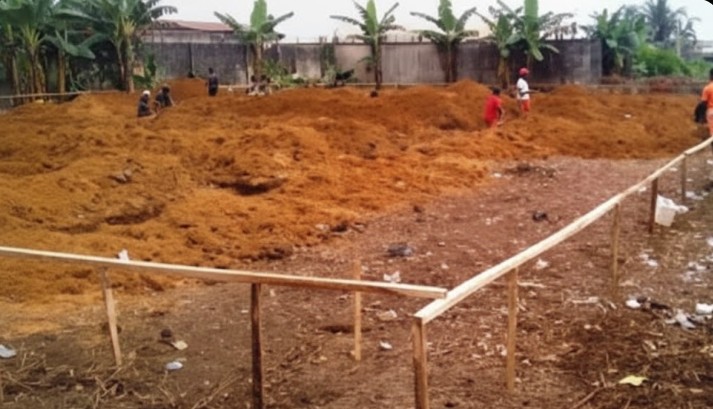
Setting out is the most critical stage of the pre-construction phase in any construction project. It is the technical process of transferring architectural and structural dimensions from paper drawings onto the actual ground. In Nigeria, where land boundaries are often tight and disputes occur frequently, a mistake at this stage can lead to legal battles or a structural disaster.
A proper setting out a building plan in Nigeria ensures that the foundation sits exactly where the architect intended. This process requires patience, the right tools, and a clear understanding of geometry. When you do it correctly, you prevent future problems with wall alignments and roofing.
Site Preparation and Essential Clearing
Before any measurements can begin, you must clear the site of topsoil, shrubs, and debris. Builders in Nigeria usually remove the top 150mm of “vegetable” soil. This soil contains organic matter that can rot and cause the building to settle over time.
You must also level the ground. A level surface ensures that your tape measurements remain horizontal and accurate. If the ground is too sloppy, your horizontal distances will be wrong, which ruins the entire setting out a building plan in Nigeria.
Essential Tools for Precise Work
To ensure precision, every Nigerian site engineer or surveyor needs specific tools. You should use a steel measuring tape (30m or 50m) instead of cloth tapes because cloth tapes stretch in the heat.
- Theodolite or Total Station: Use these for high-precision angular measurements.
- Profile Boards and Pegs: These are usually made from local hardwood.
- Nylon Lines: These strings help you mark the wall alignments clearly.
- Plumb Bob and Spirit Level: These tools ensure your lines are vertical and your levels are horizontal.
Establishing the Baseline Correctly
The baseline serves as the primary line from which you take all other measurements. Usually, you establish this building line using the survey pillars (beacons) or instructions from the Town Planning Authority.
First, identify your survey pillars on the site. Next, measure the “setback,” which is the legal distance between the road or boundary and your building. Finally, drive two pegs into the ground to mark your first main wall line. This line acts as the foundation for the entire setting out a building plan in Nigeria.
Using the 3-4-5 Rule for Squaring
Many Nigerian residential projects do not use a Theodolite. Instead, engineers use the 3-4-5 Method to ensure corners are exactly 90 degrees. This method relies on the Pythagorean theorem, which states:
a2+ b2 = c2
To apply this, measure 3 meters along your baseline from the corner peg and mark it. Then, measure 4 meters in the direction of the next wall. You must adjust the second line until the diagonal distance between these two marks is exactly 5 meters. This simple trick ensures your building is perfectly square.
Setting Up Durable Profile Boards
Once you establish the main corners, you must set up profile boards. Place these boards at least 1.5 to 2 meters away from the proposed trench. This distance ensures that laborers do not disturb the boards during the excavation process.
You should set the tops of the profile boards to a specific datum level. Most engineers use the Finished Floor Level (FFL) as a reference. You can achieve this accuracy by using a water level or a dumpy level. Reliable profile boards are the backbone of setting out a building plan in Nigeria.
Marking Wall Thickness and Excavation Trenches
After you fix the centerlines on the profile boards, you must mark the wall thickness. In Nigeria, builders typically use 225mm or 150mm blocks. You also need to mark the width of the foundation trench, which usually ranges from 600mm to 675mm.
Use a hand-axe to notch the profile boards or drive in nails to hold the strings firmly. Once you pull the strings taut, use white lime or wood ash to mark the ground. This gives the diggers a clear path to follow during excavation.
Final Checks and Diagonal Verification
Before you allow the laborers to start digging, you must perform a final diagonal check. Measure the diagonals of the entire building footprint from corner to corner. If the building is a rectangle, the two diagonal measurements must be equal.
If the diagonals are not equal, your building is “out of square.” This error will cause major issues later, especially when the carpenter tries to fix the roof. Always double-check your work to ensure a successful setting out a building plan in Nigeria. For more technical details on site surveying, you can visit The Institution of Civil Engineers.
References
- Chukwuma, O. (2021). Construction Practices in West Africa. Lagos: Academic Press.
- Obidi, E. (2019). Principles of Building Setting Out and Surveying. Abuja: TechBooks Publishing.
- Nigerian Building and Road Research Institute (NBRRI). Standard Guidelines for Foundation Works.
Leave a Reply